Content that ranks: E-E-A-T in practice
· Content · 5 min
E-E-A-T stands for experience, expertise, authoritativeness and trust. Here is how to use Google's quality framework to create content that ranks and gets used by AI assistants.
Many businesses publish content on their website regularly, only to find that their articles never climb in Google. Often the problem is not how much they write, but whether the content shows who is behind it, why they can be trusted, and whether it actually helps the reader. That is where E-E-A-T comes in.
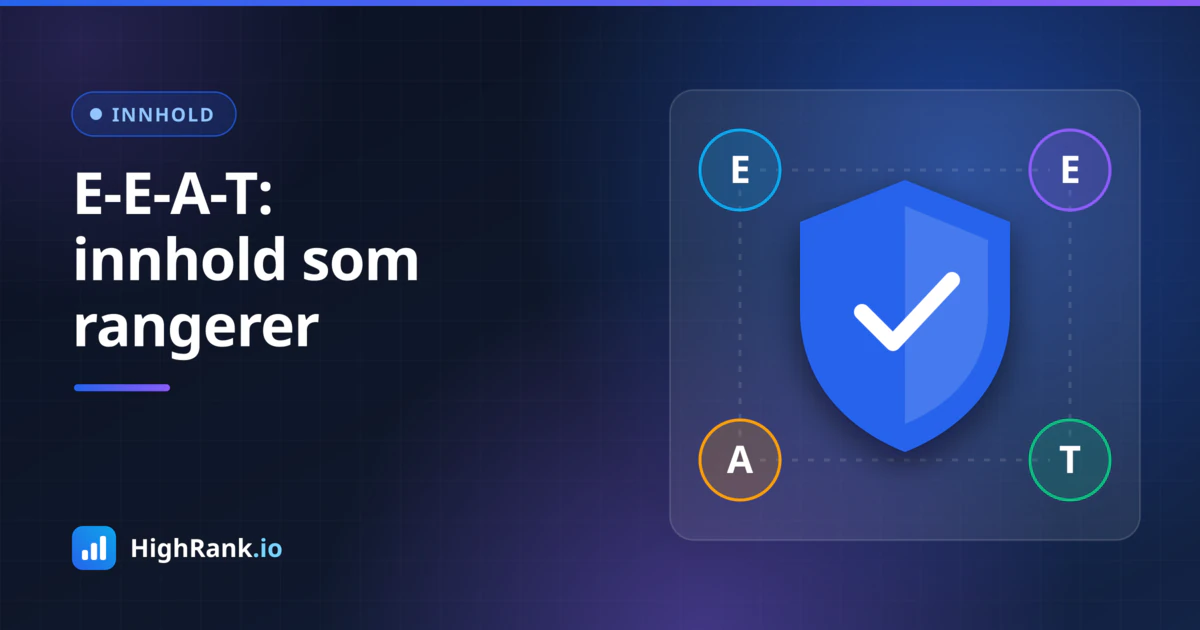
E-E-A-T stands for Experience, Expertise, Authoritativeness and Trust. In this article we explain what the concept means, what it is not, and how you can use it as a practical checklist when creating content for both Google and AI assistants.
What E-E-A-T is, and what it is not
The concept comes from Google's Search Quality Rater Guidelines, a public document Google uses to train the people who assess the quality of search results. Their ratings do not directly affect the ranking of individual pages; they are used to evaluate whether changes to Google's algorithms produce better results.
That means E-E-A-T is not a single ranking factor you can turn up or down, and there is no E-E-A-T score. Google has described it as a framework for what its systems try to reward: content made for people, by someone who knows the subject, on a site you can trust.
The four parts in brief:
- Experience: Does the author have first-hand experience with the topic? A plumber explaining how to spot a leak carries a different credibility than a generic text written without that experience.
- Expertise: Does the author have the necessary knowledge and skills? For some topics everyday experience is enough; for others formal qualifications are expected.
- Authoritativeness: Is the site or person a known and recognised source in the field? This is built over time, partly through mentions and links from others.
- Trust: Is the page honest, accurate and safe? Google describes trust as the most important of the four, with the others contributing to it.
The bar is highest for what Google calls "Your Money or Your Life" topics: content that can affect health, finances, safety or major life decisions. If you work in accounting, law, healthcare or finance, take E-E-A-T especially seriously.
Show experience: write what only you can write
The easiest way to stand out is to share experience nobody else has. Generic content on almost any topic is plentiful, and AI tools can produce it in seconds. What is hard to copy is your own observations from doing the work.
Concrete ways to bring experience to the surface:
- Describe how you actually do the job, step by step, including the judgement calls you make along the way.
- Use your own photos from projects, workshops or premises instead of stock images.
- Explain the common mistakes you see customers make and how to avoid them.
- Answer the questions customers really ask you by phone and email.
- Be honest about limitations, such as when something is not worth the money or when a customer would be better served by another solution.
A good question to ask before publishing: could anyone have written this? If the answer is yes, it probably lacks what makes it worth ranking.
Make the expertise behind the content visible
Even if your content is written by professionals, it helps little if nobody can tell. Readers and machines alike need clear signals about who is behind it.
- Show the author's name on articles and link to a dedicated author page.
- On the author page, list relevant education, experience, certifications and the topics the person covers.
- Have specialists review content on demanding topics, and consider showing who reviewed it.
- Mark up authors and your organisation with structured data, such as schema.org Person and Organization, so the connection is machine-readable.
Build authority over time
Authority is the part you control least directly, because it depends on what others say about you. It grows as relevant sources mention, cite and link to you.
Practical steps that work for small and medium-sized businesses:
- Go deep on a focused subject area rather than writing a little about everything. A site that covers one topic thoroughly comes across as a clearer source.
- Share your expertise in local media, trade publications, podcasts and industry associations.
- Make sure your business is listed correctly in relevant directories and industry registers.
- Create resources others want to link to, such as solid guides, checklists or overviews.
Trust: the most important of all
Trust concerns both the content and the website as a whole. A reader who cannot work out who runs a site, or how to contact them, has reason to be sceptical. The same goes for search engines and AI services.
Check that your website has the following in place:
- An About page explaining who you are, where you are based and how long you have been operating.
- Your full legal company name and registration number, for example in the footer.
- Contact details that are easy to find: phone, email and address.
- A privacy policy and, for online stores, clear terms of sale, shipping and returns information.
- HTTPS across the whole site.
- Genuine customer reviews, for example on Google, and replies to them.
- References to sources when you use facts, figures or regulations from others.
Keep your content up to date
Outdated content erodes trust. Prices, regulations, software and best practices change, and an article that was correct a few years ago can give the wrong advice today. Set aside time a couple of times a year to review your most important pages.
When you update, make real improvements: fix errors, add new knowledge and remove anything that no longer holds. Showing the date of the last update is helpful. Simply changing the date without changing the content adds nothing for the reader and should be avoided.
Why E-E-A-T matters for AI visibility too
AI assistants such as ChatGPT, Perplexity and Google's AI Overviews build their answers from content on the web. When they select sources, clear, credible and well-structured pages are naturally easier to use. A page that states plainly who is behind it, what the business offers and where it operates leaves AI services less to guess.
The signals that build E-E-A-T, such as consistent business information, mentions on other websites, author information and structured data, are the same signals that make it easier for an AI assistant to understand and recommend you.
E-E-A-T is not a shortcut or a technical trick, but a useful framework for creating content that deserves to rank. Share your own experience, show who is behind the content, build your reputation over time and make it easy to trust you. Start with your most important pages and work your way down. If you want to see how your website comes across today, both in Google and in AI assistant answers, you can check it with an analysis on HighRank.io.